
|
|
 |
|
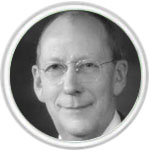
The History Corner: STANLEY MOORE WYMAN |
|
Stanley Moore Wyman (1913-1996) was an American radiologist and a renowned specialist in the gastrointestinal field, who developed his entire career at the Massachusetts General Hospital. President of the American College of Radiology and the Radiological Society of North America, he was awarded the Gold Medal of both institutions. Born in Cambridge, he completed his primary studies in the public schools of the area and later at Harvard College, graduating in medicine from Harvard Medical School in 1939. He began his residency in radiology at Massachusetts General Hospital (MGH) under the tutelage of the prestigious Georges W. Holmes, at a time when the Department of Radiology was filled with historical figures such as Awbrey Hamptom, James Lingley and Richard Schatzki, among others. During his first year of residency, coinciding with the outbreak of World War II, the MGH organized a volunteer unit that was integrated into the Army Medical Corps. Stan was part of this group, which after being trained in Florida was sent to Casablanca in North Africa, from there to Naples to participate in the Italian campaign, and finally to the Po Valley, where the defeat of the German army culminated. For his services, young Stan received the Bronze Star and five Battle Stars. He is also remembered for having installed the first field fluoroscopy unit in North Africa; he actually did this to carry out the fluoroscopic chest examination of Winston Churchill, who had suffered a cold during one of his visits, although the equipment was later used to examine the war wounded. On his return to the MGH in 1946, he completed his residency and joined as a staff radiologist, cooperating in the development of a radiological research laboratory, which soon housed an experimental angiocardiography apparatus that, led by Dr. Wyman, was supported by MGH surgeons and cardiologists. Several of the models developed by this working group, at a time when no commercial angiocardiographic equipment was available, were subsequently adopted for clinical use. Subsequently, Dr. Wyman, together with Frank Schultz, developed a device that allowed dynamic imaging of the heart. He achieved a solid prestige in the field of digestive radiology; he carried out, together with his collaborators, the first controlled clinical trial to evaluate different pharmacological methods of controlling gastrointestinal motility during radiological studies. A great educator, his devotion to his students and their devotion to their teacher was legendary. For many years he moderated the case discussions of the noon sessions, earning the endearing nickname “Whispering Stan” as he quietly commented on observations and responses to residents having difficulty resolving the case presented. With multiple interests, including a love of airplanes and gliders, he was a member of the Economy Club of Cambridge and the Aesculapian Club of MGH. President of the American College of Radiology (ACR), he served as Chairman of the Board of Chancellor of the ACR. He was also President of the Radiological Society of North America (RSNA) and the New England Roentgen Ray Society. He was awarded the Gold Medal of the ACR and the RSNA and the Silver Medal of the American Roentgen Ray Society. At MGH, he established the prestigious Hampton Lecture (1968), which in recent years has featured the Stanley Moore Wyman Resident Award dedicated to honoring the most outstanding MGH resident for integrity, dedication, and excellence. He was always the first person to arrive at the hospital, and for the rest of the morning, sitting in front of his negatoscope, “Stan's place,” he dispensed advice, caution, encouragement, and good humor to anyone who came to greet him in need. Autor: |
|
 |
 |
 |
 |
 |